
Your high-performance stack is a wasted investment without a precise delivery schedule. Precision is the difference between biological utility and expensive waste. You prioritize purity. You demand transparency. Yet, despite a high-quality intake, your recovery remains suboptimal and your training energy fluctuates. It's a failure of system integration, not ingredient quality. Haphazard consumption leads to inconsistent results and a diminished return on your nutritional capital.
We agree that guessing is not a strategy for the serious athlete. This guide provides a systematic protocol for supplement timing for athletic performance to optimize every milligram you ingest. You'll master the timing of performance nutrition to align with your body's specific biological windows and training demands. We're moving beyond the "anabolic window" myth into a data-driven, repeatable timing system. We will analyze the pharmacokinetics of your stack, establish a rigid training-day schedule, and maximize the structural integrity of your output. This isn't marketing. It's a technical manual for your biological hardware.
Key Takeaways
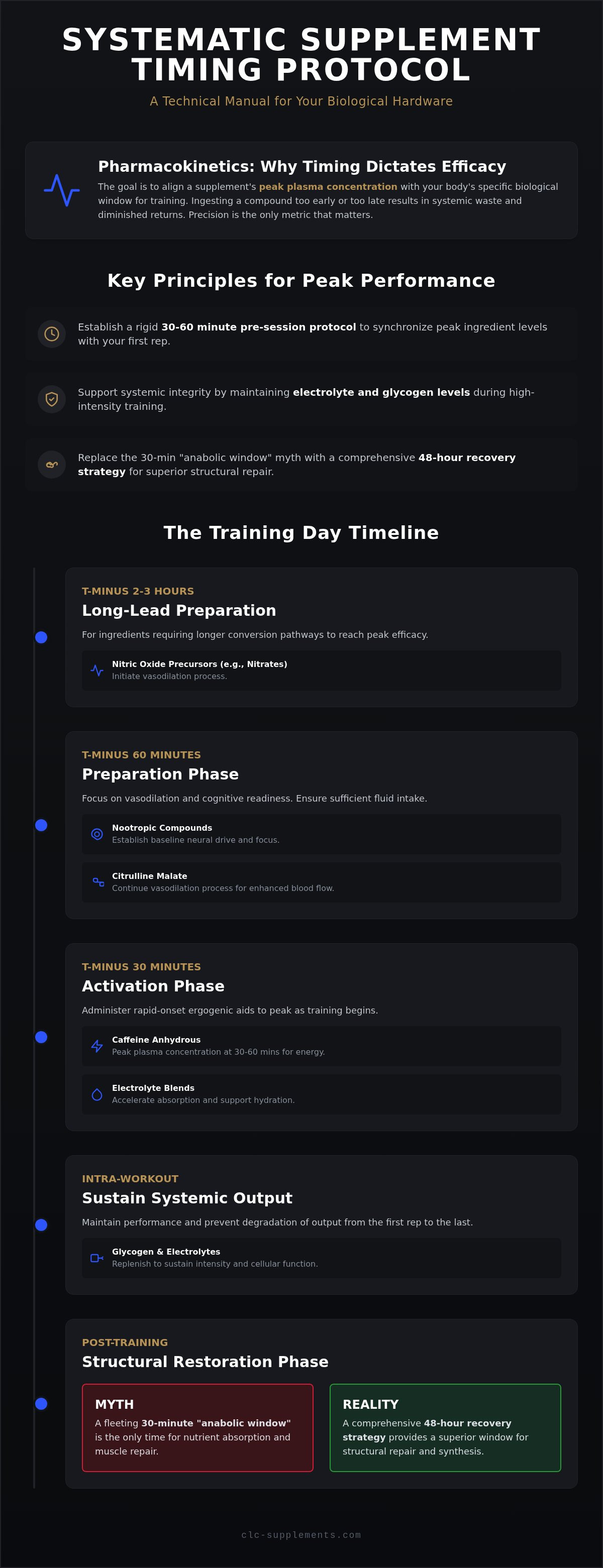
- Identify the peak plasma concentration of each ingredient to align intake with your body's specific biological window.
- Master the precision of supplement timing for athletic performance by establishing a rigid 30, 60 minute pre-session protocol.
- Support systemic integrity during high-intensity training by maintaining electrolyte and glycogen levels from the first rep to the last.
- Replace the 30 minute anabolic window myth with a comprehensive 48 hour recovery strategy for superior structural repair.
- Leverage transparent labeling to perform exact timing calculations and maximize the ROI of your performance nutrition.
Pharmacokinetics of Performance: Why Timing Dictates Biological Efficacy
Pharmacokinetics is the study of ingredient absorption, distribution, and peak plasma concentration. In the context of sports nutrition, it is the technical blueprint for your results. Precision matters. Ingesting a compound too early or too late results in systemic waste. Mastering supplement timing for athletic performance requires a clinical understanding of these metabolic timelines. You aren't just consuming nutrients; you are managing a biological delivery system. Efficiency is the only metric that matters.
The Biological Window represents the specific duration where an ergogenic aid provides maximum systemic support. This is a foundational concept in any Nutrient Timing Overview. Outside of this window, the efficacy of the dose drops significantly. Bioavailability determines the outcome. Your delivery format and timing determine how much of the dose your body actually utilizes for training output. If the delivery fails, the formulation is irrelevant.
Distinguish between chronic loading and acute timing. Creatine requires a chronic loading phase to achieve cellular saturation. Its immediate timing is less critical than its daily consistency. In contrast, caffeine and nitrates operate on acute timelines. They require precise administration to align with peak demand. Without this distinction, your protocol lacks structural integrity. Data dictates your protocol. Results follow the data.
The Mechanism of Peak Plasma Concentration
Ingredients reach peak levels in the bloodstream at varying rates. This is the metric of success. Caffeine typically hits peak plasma concentration within 30 to 60 minutes of ingestion. Nitrates, however, require a significantly longer lead time of two to three hours to convert into nitric oxide effectively. Your Standard Operating Procedure must account for these offsets. Time your intake based on ingredient onset. Do not rely on generic instructions. Accuracy is a requirement for the serious athlete.
Bioavailability and Digestive Transit
Gastric emptying rates dictate the performance window. High fiber or high fat intake can delay metabolic transit. This shifts your peak concentration further into your training session, or worse, past it. Co-ingestion is a variable you must control. Combining specific carbohydrates with electrolytes can accelerate absorption. Conversely, excessive fats can stall the process. Bioavailability is the fraction of an unchanged supplement that reaches systemic circulation. Control the environment to ensure the dose reaches the target tissue on schedule. Consistency is the product of discipline.
The Pre-Training Protocol: Optimizing Acute Performance Parameters
Acute performance depends on systemic readiness. The 30 to 60 minute pre-session window is the primary parameter for supplement timing for athletic performance. During this phase, the objective is to synchronize peak plasma concentration with the start of your first set. Timing is as critical as the dosage itself. Ingesting compounds too close to training onset results in peak efficacy occurring mid-session, leaving the initial reps undersupported.
A significant barrier to this precision is the proprietary blend problem. If a label obscures specific dosages, calculating the metabolic lead time becomes impossible. You cannot optimize what you cannot measure. Technical rigor requires transparency. This is why CLC Formula Supplements prioritize clear, third-party verified labeling. Knowing the exact milligram of each ingredient allows you to map your intake to your specific metabolic rate.
The 60-Minute Preparation Phase
This phase focuses on vasodilation and cognitive focus. Nitric oxide precursors and focus-based ingredients require longer metabolic pathways to reach systemic availability. According to the ISSN Position Stand on Nutrient Timing, the strategic ingestion of these compounds ensures they are active when the physical demand begins. Use this checklist to verify your readiness:
- Confirm intake of nitrates or citrulline malate to initiate the vasodilation process.
- Administer nootropic compounds to establish baseline neural drive.
- Ensure fluid intake is sufficient to support blood volume expansion.
The 30-Minute Activation Phase
The final 30 minutes before training focus on rapid-onset ergogenic aids. Caffeine anhydrous and specific electrolyte blends belong in this window. These ingredients work to reduce the Rating of Perceived Exertion (RPE). This allows for higher intensity output from the start. Hydration levels must be stabilized during this phase. Entering a session with fluctuating fluid balance compromises the efficacy of the entire stack. Stability is the foundation of high-performance output.
Intra-Workout Maintenance: Sustaining Systemic Output
Intra-workout maintenance is the tactical management of systemic integrity. It begins after the first rep and continues until the session concludes. High-intensity training creates an immediate metabolic deficit. Glycogen stores drop as the body prioritizes ATP production. Electrolytes are lost through perspiration and cellular demand. This depletion is not merely a fatigue factor; it is a mechanical failure of the system. For athletes engaged in sessions exceeding 60 to 90 minutes, intra-workout intervention is a structural requirement. It prevents the performance drop-off that occurs when internal resources are exhausted. Without a steady supply of substrates, your training output will inevitably diminish.
The MSU Guide to Nutrient Timing highlights that maintaining hydration and substrate availability during exercise is critical for sustained power. This is where supplement timing for athletic performance shifts from preparation to active maintenance. You are no longer priming the system. You are fueling the engine while it's under load. Precision here ensures that the final set is as impactful as the first. Consistency in delivery is the only way to avoid the systemic crash associated with long-duration intensity.
Electrolyte Balance and Osmotic Pressure
Intra-workout timing prevents cellular dehydration by managing osmotic pressure. Sodium, potassium, and magnesium are the chemical triggers for muscle contraction. They facilitate the electrical impulses required for movement. Precision in electrolyte ratios is required to maintain neural signaling and muscle fiber recruitment. Haphazard hydration is insufficient. You need a calculated delivery of ions to sustain performance output:
- Sodium: Maintains fluid balance and nerve impulse transmission.
- Potassium: Prevents muscle cramping and supports heart function.
- Magnesium: Facilitates ATP metabolism and muscle relaxation.
Proper timing ensures these minerals are available as the sweat rate increases. It maintains the internal environment required for peak force production. When these ratios are correct, the mechanical integrity of the muscle remains intact.
Amino Acid Signaling During Resistance
Essential amino acids (EAAs) serve a dual purpose during training. Technical data shows that EAA ingestion during a session triggers muscle protein synthesis while the load is still being applied. This creates an anti-catabolic effect. It mitigates muscle protein breakdown during high-stress sets. Intra-workout EAAs act as a systemic safeguard against excessive muscle tissue oxidation. By providing a readily available pool of amino acids, you prevent the body from scavenging its own structural tissue for energy. This is engineering for longevity. It allows you to maintain a positive nitrogen balance even during the most demanding phases of your training architecture.
Post-Training Restoration: The Recovery Window as a Structural Requirement
The "30-minute anabolic window" is a simplified marketing construct. Real-world recovery is a 24 to 48-hour cycle of systemic repair. While immediate nutrient ingestion is advantageous, it is only the first phase of a long-term structural requirement. High-performance supplement timing for athletic performance involves managing this entire window. You must prioritize glycogen resynthesis and the immediate initiation of muscle protein synthesis. Failure to do so extends the state of catabolism. This delays your return to baseline readiness and compromises your next training session.
Training is a sympathetic, high-stress event. Transitioning into a parasympathetic state is the first step of restoration. Post-session nutrition acts as the chemical signal to downregulate cortisol and initiate repair. By providing the system with rapid-digesting substrates, you terminate the catabolic phase. You move from structural breakdown to structural integrity. This transition is the foundation of long-term training adaptation. Precision here is non-negotiable for the serious athlete.
Glycogen Resynthesis Protocols
The immediate post-workout period is optimal for glucose transport. Muscle cells are highly sensitized to insulin during this time. This insulin-mediated response allows for efficient nutrient partitioning. It drives glucose directly into the depleted muscle tissue rather than adipose stores. To achieve rapid restoration, follow a specific ratio of carbohydrates to protein. A technical specification for this process includes:
- Glucose Transport: Facilitated by GLUT4 translocation during and after mechanical load.
- Insulin Sensitivity: Peak metabolic receptivity occurs in the first 60 minutes post-session.
- Restoration Ratio: A 3:1 carbohydrate-to-protein ratio ensures optimal partitioning and glycogen loading.
Initiating Muscle Protein Synthesis (MPS)
To trigger the mTOR pathway, you must achieve the Leucine Threshold. This technical requirement typically demands a minimum of 2.5 grams of leucine in a single bolus. High-quality protein isolates are the necessary hardware for this task. They provide the rapid metabolic transit required to maximize the repair of micro-trauma before the window of heightened sensitivity closes. In 2026, competitive longevity is dictated by the speed of your systemic restoration. Precision in this window is a requirement for serious athletes. For formulas engineered to meet these specific recovery parameters, integrate Recovery Supplements into your post-session protocol.
The CLC Engineering Standard: Integrating Timing into Your Training Architecture
Precision requires data. Without transparent labels, your calculations for supplement timing for athletic performance are based on guesswork. CLC Supplements eliminates this variable. Every formula is a set of specifications. We provide the exact milligram of every active ingredient. This allows you to map your intake to the pharmacokinetic windows discussed in previous sections. If you don't know the dose, you don't know the timing. Transparency is the only path to systemic optimization.
Third-party testing is our primary verification protocol. It ensures that the label matches the contents with absolute accuracy. For the elite athlete, this is a matter of risk mitigation and performance validation. We treat our supplements as technical hardware. They're engineered to support your system from the first rep to the last. This consistency is the foundation of a repeatable training architecture. When the hardware is reliable, the protocol succeeds.
Verification Protocols for Elite Athletes
Lab-tested ingredients are non-negotiable for competitive integrity. We employ clinical dosing to align with established metabolic windows. This isn't about marketing claims; it's about academic-grade formulation. Each dose is calibrated to reach peak plasma concentration when you need it most. Our commitment to technical rigor ensures that your biological windows are fully utilized. We provide the documentation. You provide the effort. This partnership ensures that no milligram is wasted on suboptimal timing.
Our "No Filler" policy is a prerequisite for predictable digestive transit times. Fillers and proprietary blends introduce metabolic variables that can delay gastric emptying. This unpredictability ruins a timing protocol. By removing unnecessary additives, we ensure that the onset of action is consistent across every training session. You can rely on the timing because the formulation is clean. Predictability is the hallmark of professional-grade nutrition.
Standard Procurement: Building Your Performance Stack
Selecting the right formula depends on your specific training parameters. You need high-specification hardware that matches your physiological demands. The direct-to-consumer (DTC) model provides a distinct advantage. You get direct access to high-specification formulas without retail markup or compromised standards. It's a professional solution for the disciplined athlete who values process as much as results. Optimize your timing with CLC Performance Nutrition Formulas and ensure every milligram contributes to your training output. Stop guessing. Start engineering your performance.
Systemic Optimization: The Path to Peak Training Efficacy
Mastery of supplement timing for athletic performance is the final stage of a professional training architecture. You've moved beyond haphazard consumption into a protocol defined by pharmacokinetics and biological windows. Precision is a requirement for elite output. Success depends on the structural integrity of your stack. Without transparent labels and rigorous third-party validation, your timing calculations lack the necessary metabolic precision. You're no longer just consuming nutrients; you're engineering a systematic response.
We provide the technical hardware for this methodology. Every batch we produce is third-party lab tested for purity and accuracy. Our 100% transparent labels eliminate proprietary blends, allowing you to calculate your intake to the milligram. These formulas are engineered for elite athletic specifications to ensure your results are repeatable and verified. You've established the protocol. Now, secure the hardware required to execute it.
View the CLC Performance Nutrition Catalog for Clinically Dosed Formulas. Your discipline in the gym deserves a nutrition system that operates with the same uncompromising rigor. Execute your next session with absolute confidence.
Frequently Asked Questions
How long before a workout should I take a pre-workout supplement?
Ingest your pre-workout formula 30 to 60 minutes before your session begins. This duration allows for optimal gastric emptying and ensures that stimulants like caffeine reach peak plasma concentration as you start your first set. Nitric oxide precursors often require the full 60 minute lead time to facilitate systemic vasodilation. Precise timing ensures the ergogenic effect aligns with your peak training demand.
Does the timing of creatine intake actually matter for performance?
Daily consistency is the primary requirement for creatine efficacy. The objective is achieving and maintaining cellular saturation. While some technical data suggests a marginal advantage to post-workout ingestion for nutrient uptake, the difference is negligible compared to total daily intake. Maintain a steady 3 to 5 gram dose every 24 hours to keep your systemic levels optimized for ATP production.
Is the anabolic window after a workout a real scientific requirement?
The traditional 30 minute anabolic window is a marketing simplification. Scientific restoration actually occurs over a 24 to 48 hour cycle. However, immediate post-training nutrition is a structural requirement to initiate the transition from a catabolic to an anabolic state. Prioritize protein and carbohydrate ingestion within two hours of your session to maximize the rate of glycogen resynthesis and muscle tissue repair.
Can I take all my supplements at once in the morning?
Taking all supplements simultaneously is inefficient due to varying pharmacokinetics. Different compounds reach peak concentration at different rates. Stimulants and vasodilators belong in the pre-workout window. Recovery agents belong in the post-workout phase. Strategic supplement timing for athletic performance requires distributing your stack to match specific biological demands throughout the training day. Haphazard ingestion leads to systemic waste.
How does caffeine timing affect training sessions late in the day?
Caffeine has a half-life of approximately 5 to 6 hours. Late-day ingestion can significantly disrupt sleep architecture, which is the foundation of structural recovery. If you are training after 4:00 PM, consider reducing the dose or utilizing non-stimulant vasodilators. You must prioritize long-term recovery over acute stimulation to maintain your endocrine balance and overall training longevity.
What is the best time to take BCAAs or EAAs for muscle preservation?
Intra-workout administration is the optimal protocol for essential amino acids (EAAs). This timing provides a steady stream of substrates to mitigate muscle protein breakdown during high-intensity sets. It serves as a systemic safeguard against tissue oxidation. Ingesting EAAs from the first rep to the last maintains a positive nitrogen balance and triggers protein synthesis signaling while the load is still being applied.
Does supplement timing change based on fasted vs. fed training states?
Fasted training requires more aggressive amino acid timing to prevent excessive catabolism. In a fed state, your body utilizes existing nutrient pools. In a fasted state, you must provide exogenous EAAs immediately before or during training to protect muscle tissue. Adjust your supplement timing for athletic performance to account for these metabolic differences and ensure systemic stability during high-intensity output.
How do I adjust my supplement timing for endurance vs. strength training?
Endurance protocols prioritize intra-workout electrolyte and carbohydrate delivery to maintain glycogen levels. Strength protocols focus on pre-workout neural drive and post-workout structural repair. Both require precise timing, but the substrates differ. Endurance athletes should consume nutrients every 30 to 45 minutes during long sessions. This prevents the systemic crash associated with substrate depletion and maintains mechanical integrity.